Sunday Lunch, Shared Loyalty: Setting Kind Limits with In-Laws Without Dividing the Marriage

Marriage changes the geometry of family life. Two people become a unit, but the families that raised them do not disappear; nor should they. In the UK, Sunday roasts, Christmas rotas, bank holiday visits and family WhatsApp groups can be sources of real warmth. They can also become the ground on which a couple quietly loses its footing. The so-called mother-in-law clause is not a legal term. It is shorthand for a common tension: how to stay loyal to parents without becoming disloyal to a spouse.
Boundaries are not rejection
A boundary is a statement about what a couple will do, not a punishment for what a relative has done. Kind boundaries protect time, privacy and decision-making. They are not cold. They are the conditions under which warmth can survive.
It helps to separate preference from intrusion. A parent preferring a particular Christmas routine is not automatically controlling. A parent ringing several times a day, commenting on household spending or arriving without notice is a different matter. The question for the couple is not “Who is right?” but “What pattern are we creating, and is it sustainable?”
One voice, two people
One of the most useful counselling insights is simple: in-law difficulties are usually managed best by the couple, not by the in-law. That means talking privately first, agreeing what will be said and deciding who will say it. If one partner speaks to a parent without agreement, the other can feel exposed and undermined. If the couple speaks as a unit, the boundary is more likely to hold.
Useful wording includes: “We have talked about this together, and we have decided…” Avoid “She says…” or “He thinks…”, which can turn a shared decision into a family argument. The aim is not secrecy. It is a united front built on private agreement.
Sunday lunch and the weekly rhythm
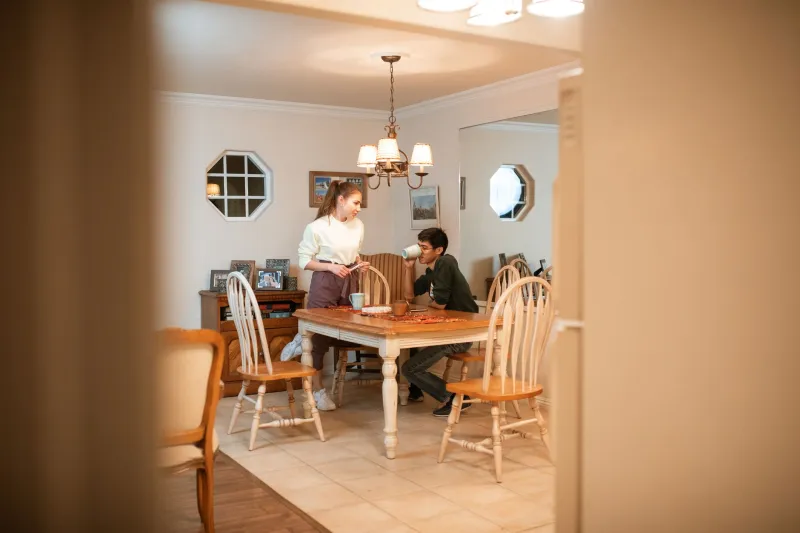
Sunday lunch is a beloved institution, but it can also become an assumed obligation. Couples often need a rhythm rather than a rigid rule. That might mean alternating Sundays, hosting at home once a month or visiting after lunch rather than staying for the whole day.
Ready-to-use scripts can reduce heat:
- “We would love to come this Sunday. We will need to leave by four, as we have plans later.”
- “We are going to alternate Sundays for a while so we can protect some time at home. We will let you know which dates work.”
- “Thank you for asking. This week does not work for us, but we could come the following weekend.”
Notice what these scripts do not do. They do not over-explain, blame or offer a long defence. A short, warm reason is usually enough.
Holiday rotas and the Christmas question
Holiday expectations can be especially intense. Christmas Day, Boxing Day, New Year and bank holidays carry decades of family tradition. Couples often feel they are choosing between two families rather than choosing a life together.
The earlier the conversation, the kinder it tends to be. Agree in October or early November what the couple can realistically manage. Then tell both families together, or at least with consistent wording. For example: “This year we are spending Christmas Day at home, just the two of us. We would love to see you on the 27th.” Or: “We can do Christmas Eve with your family and Boxing Day with mine; next year we will swap.”
A rota can be useful, but it should be a guide rather than a life sentence. Couples need room to change plans without triggering a family crisis.
Advice, parenting and the art of the warm no
Advice often arrives with love behind it. That does not mean it must be followed. When a parent comments on parenting, careers, house-buying or money, the couple can acknowledge the care while keeping the decision.
Try: “We know you are offering that because you care. We are going to try our own approach for now.” For parenting specifically: “We have decided to follow the health visitor’s advice on this.” For repeated questioning: “We will let you know when there is news to share.”
Private information is also a boundary. Couples should agree what is shared with extended family and what stays between them. Not every disagreement needs to become a family topic.
The monthly check-in for couples
A short monthly check-in can prevent small irritations from becoming a loyalty contest. Fifteen minutes is enough. Ask: What felt supportive from relatives this month? What felt intrusive? What do we need to say next? What can we let go?
Agree not to discuss in-law tensions late at night or in the middle of a family visit. A pause is not avoidance; it is a way of keeping the conversation constructive.
When to seek specialist support
If in-law tensions are leading to repeated arguments, avoidance, secrecy or contempt, the issue has become a relationship issue. Specialist counselling can help couples rehearse difficult conversations, understand loyalty conflicts and strengthen their shared boundary. The work is not about blaming relatives. It is about helping the couple feel safe enough to act as a team.
Kind limits are not a rejection of family. They are a way of making room for both the marriage and the wider family to breathe.